
Context:
This unit is designed for use with classes in the upper secondary levels - seniors, juniors and potentially sophomores. It can be used with students of all ability levels, however, for remedial or special needs students, some adaptations must be made. The basic framework of the unit is sound for all socio-economic and geographic distributions of students. The specific reading, listening and viewing materials are to be modified to meet student needs and interests. As this is a unit on social change, the issues discussed should be relevant to the society in which the students function. Because of this, flexibility of subject matter has been incorporated as an aspect of the unit.
Focus:
This unit is designed around the theme of Literature as Social Change. It will explore the different voices of societal change that are found in literature. The unit will include a variety of different genres, however, all will be thematically related. This will allow for both cross-genre comparisons and creative endeavors. Students will have had experience with multiple genres before this unit (this will be important for their unit project).
Goals:
Literature is the fundamental voice of society. It both expresses the human condition and serves as a force for societal change. It reflects the world around us, and in doing so, affects its development. After this unit, students will see the reciprocal relationship between society and literature. They will understand the role that literature plays in shaping our world. But most importantly, they will understand how literature gives power to the individuals within the masses and how it can give them a voice to be heard.
Objectives:
By understanding the basic dynamics of literature, society and power, students will be able to discuss the different voices of change and critique their effectiveness. Students will be able to exercise their own voice for societal change through an authentic semester project - a creative endeavor addressing an issue that is personally relevant to them. Through an analytical written project, they will also contrast, compare and analyze the efficacy of different methods used in varying literary contexts to procure social change. Finally, students will be able to integrate public speaking skills and rhetorical devices in an oral presentation that demonstrates personal, social and civic awareness for the purpose of persuading an audience.
Day by Day Plans
Monday
Students will listen to "Changes" by 2Pac Shakur. They will be given a handout of the lyrics. Class discussion about the social issues raised in the song. Then they will be given the Langston Hughes handout with "Mother to Son" on it. Direct mini-lesson on the blues and early African-American music and the social issues surrounding them. Small group discussions analyzing the poem and comparing the song and poem. The last five minutes of class have students write in their journal to give them a chance to reflect on the day's lesson.Homework: write at least ten lines of poetry or "blues" that addresses a social issue of your own.
Tuesday
Collect homework - poem/blues. Discuss issues that were raised by the homework assignment. Continue with Hughes Poetry - "The Weary Blues" and "I, too, sing America" Introduce Zora Neale Hurston and other writers of the Harlem Renaissance. Students will listen to voice recordings of various Harlem Renaissance authors reading their own works. They will then write in their journals what they think the readings mean. Afterwards, we will discuss this as a class.Introduce the Unit Creative Project. Students will need to choose genres and their social issue by tomorrow.
Homework: Students will choose a H.R. poem or passage (very short) to memorize and perform for the class on Thursday.
Wednesday
Return blues/poem homework assignment.Beginning class activity - brainstorming different kinds of social issues and genres that can address them. Students must have chosen a genre and issue for their Creative Project. This is to be submitted today for teacher approval.
Read "Black Death," by Hurston. The students will then create a found poem from the text. This will be turned in at the end of the hour.
Thursday
Return students found poems and their Creative Project choices.Students will present their memorized poems or passages in class. Present reproduction of the painting "Abraham Lincoln" by William H. Johnson. Have students write their own interpretation of the painting in their journals. Then discuss Johnson and what the painting means.
Friday
Discuss the citizen's role in a democracy. Read "Introduction to a Public Citizen's Action Manual", by Ralph Nader. Relate this to Rosa Parks and the Montgomery Bus Boycott. Students will then be given roles in the creation of a micro-drama. They will give a short play on the events of December 1, 1955, when Mrs. Rosa Parks was told to give up her seat on the bus. Act out her arrest then show her explaining the reasons for her action to a group of reporters after she has been released from jail. The rest of the hour will be spent creating the drama. It will be performed Monday*.Remind students that their Creative Project Bibliography of Resources is due on Tuesday and Part One is due on Wednesday (This shouldn't be a problem. Explain to the students that they should be working on Part One in order to complete the Bibliography.)
*based on "Non-violent Protest Through the Ages," lesson plan by Olivia
J. Green
Monday
Students will give their performance of the events surrounding Rosa Parks arrest. Begin literature circles. Students will be given a list of books and a brief summary of what each is about. They will then choose the book that they want to read - no more than five students to a book. We will start in class work on the books in three weeks.Remind students that their Creative Project Bibliography of Resources for their Creative Project is due tomorrow and Part One is due Wednesday.
Introduce War into the classroom (the song, not the actuality). Discuss Viet Nam and the protests it sparked - Kent State et al.
Homework: Read handout of war poetry.
Tuesday
Begin class with music of U2, Bob Dylan, and Joan Baiz. Discuss the lyrics of the songs. Then relate them to the poetry that was read for homework. Students will then write a comparison/analysis of the songs and poems in their journals. We will discuss the different techniques that are used in the pieces, then the remainder of the hour will be spent writing an imitation of one of the works that we have covered so far. This will be due Thursday.The Bibliography of Resources for their Creative Project is due today. Remind the students that they MUST bring in their initial draft of Part One of their Creative Project tomorrow for peer editing.
Homework: Finish Imitation Assignment by Thursday.
Wednesday
The entirety of the hour will be spent in Peer Editing for Part One of the Creative Project. Students are to get critical feedback from at least three other students in the class. They will work in groups of two, editing each others project. Every 1/3 of the hour, the teacher will instruct them to switch partners.Homework: Read "Dover Beach" by Matthew Arnold
Thursday
Collect the student's Imitation homework assignment. Discuss "Dover Beach" in depth - walk the students through a line-by-line analysis. Play Samuel Barber's song "Dover Beach" written around Arnold's text. If possible segue this into Barber's Adagio and the scene from Platoon where it is used. If not, create my own visual presentation set to this music. From poetry to art song to theatre, trace this anti-war theme through the genres.
Friday
Return student's Imitation homework assignment.Back to Table of ContentsRemind Students that the first draft of Part One of their Creative Project is due on Monday.
Present Holocaust image and poetry. Discuss the picture and poem. Then have students write their own poem and journal entry about the picture.
Monday
The first draft of Part One of the Creative Project is due today. Introduce Henry David Thoreau. Give background lecture for ideas, terms and social context that students will need to understand Civil Disobedience.TuesdayHomework:
- read Civil Disobedience.
- Find an example of a piece of literature (any genre, including song lyrics) that was written (at least in part) for the purpose of social change. This will be presented to the class on Friday.
Discuss Civil Disobedience. Do the students agree with Thoreau's beliefs? They will write a response to the essay in their journals. Relate the ideas discussed in Civil Disobedience with the philosophies of Ghandi. Give background information about Ghandi and the social environment at the time. Play Audio Clips from Ghandi's speeches. Discuss our roles as world citizens.Food for thought selection.
Wednesday
Return the first draft of Part One to the students for revision.Watch "I have a Dream - The Life of Dr. Martin Luther King, Jr." (35 minutes). After viewing, students will write a paragraph reader-response to the film and a paragraph tracing the influences of Thoreau and Ghandi.
Thursday
Today will be a field trip to the Instructional Media Center to do biographical research on Thoreau, King or Ghandi. We will gather information today for our homework assignment.Remind students to bring in examples of words of social change to present to the class tomorrow.
Homework: write a brief (1 page) biographical sketch of Thoreau, King or Ghandi. This will be due tomorrow.
Friday
Students will present their found examples of words of social change. Biographical sketch is due. Representative examples will be posted around the classroom.Back to Table of ContentsRemind students that the final draft of Part One of their Creative Project is due on Monday.
Monday
The final draft of Part One of our Unit Creative Project is due today. We will do an in-class writing assignment today. Discuss what students perceive women's strengths to be. List them on the board. Now list what strengths society values. Do they coincide? Students will then write about a strong woman in their life using their choice of genre. Then in their journals, they will compare this woman with three women they have encountered in their readings in the class to date*.TuesdayHomework: Read "Shakespeare's Sister" by Virginia Woolf tonight.
First half of class will be spent discussing "Shakespeare's Sister" and writing a short (15 minute) essay evaluating its merits and applicability to today's society. The students will write this reader-response to the essay in their journals.WednesdayWe will spend the second half of the class period working on our Self-Evaluations for the Creative Project. What is not finished in class will be completed as homework. The Self-Evaluations are due tomorrow.
Self-Evaluations are due for the Unit Creative Projects. We will read in class Kate Chopin's "The Story of an Hour." We will discuss the issues raised in the text and then respond in our journals.ThursdayHomework: read "Desiree’s Baby," by Kate Chopin
Students will begin to write an in class skit. Working in groups of four or five, they will write a dramatization of a feminist issue that was brought up in our readings. We will brainstorm these ideas. Students will then get together and rehearse their skit. These will be presented in class tomorrow*.Friday
Presentation of skits. This should take most of the hour. If there is time left, we will discuss the issues raised in the various skits.*based on a lesson from "Women Writers and Dissent in 20th and 21st Century Amerian Literature," by Leslie FellowsOn Monday we will begin our In-Class presentations of our Literature as Social Change Creative Projects. Five students will give their presentation each day. The presentations will take one week of class time.
Unit Materials
Day by Day Materials
Monday - 2 Pac 2 Hughes

-1- Come on come on
I see no changes wake up in the morning and I ask myself
is life worth living should I blast myself?
I'm tired of bein' poor & even worse I'm black
my stomach hurts so I'm lookin' for a purse to snatch
Cops give a damn about a negro
pull the trigger kill a nigga he's a hero
Give the crack to the kids who the hell cares
one less hungry mouth on the welfare
First ship 'em dope & let 'em deal the brothers
give 'em guns step back watch 'em kill each other
It's time to fight back that's what Huey said
2 shots in the dark now Huey's dead
I got love for my brother but we can never go nowhere
unless we share with each other
We gotta start makin' changes
learn to see me as a brother instead of 2 distant strangers
and that's how it's supposed to be
How can the Devil take a brother if he's close to me?
I'd love to go back to when we played as kids
but things changed, and that's the way it is
Bridge w/ changing ad libs
Come on come on
That's just the way it is
Things'll never be the same
That's just the way it is
aww yeah
Repeat
-2- I see no changes all I see is racist faces
misplaced hate makes disgrace to races
We under I wonder what it takes to make this
one better place, let's erase the wasted
Take the evil out the people they'll be acting right
'
cause both black and white is smokin' crack tonight
and only time we chill is when we kill each other
it takes skill to be real, time to heal each other
And although it seems heaven sent
We ain't ready, to see a black President, uhh
It ain't a secret don't conceal the fact
the penitentiary's packed, and it's filled with blacks
But some things will never change
try to show another way but you stayin' in the dope game
Now tell me what's a mother to do
bein' real don't appeal to the brother in you
You gotta operate the easy way
"I made a G today" But you made it in a sleazy way
sellin' crack to the kid. " I gotta get paid,"
Well hey, well that's the way it is
Bridge Talking: We gotta make a change... It's time for us as a people to start makin' some changes. Let's change the way we eat, let's change the way we live and let's change the way we treat each other. You see the old way wasn't working so it's on us to do what we gotta do, to survive.
-3- And still I see no changes can't a brother get a little
peace
It's war on the streets & the war in the Middle East
Instead of war on poverty they got a war on drugs
so the police can bother me
And I ain't never did a crime I ain't have to do
But now I'm back with the blacks givin' it back to you
Don't let 'em jack you up, back you up,
crack you up and pimp slap you up
You gotta learn to hold ya own
they get jealous when they see ya with ya mobile phone
But tell the cops they can't touch this
I don't trust this when they try to rush I bust this
That's the sound of my tool you say it ain't cool
my mama didn't raise no fool
And as long as I stay black I gotta stay strapped
& I never get to lay back
'Cause I always got to worry 'bout the pay backs
some buck that I roughed up way back
comin' back after all these years
rat-a-tat-tat-tat-tat that's the way it is uhh
Poem: "Mother to Son" by Langston Hughes
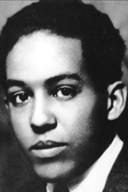
Well, son, I’ll tell you:
Life for me ain’t been no crystal stair.
It’s had tacks in it,
And splinters,
And boards torn up,
And places with no carpet on the floor –
Bare.
But all the time
I’se been a-climbin’ on,
And reachin’ landin’s,
And turnin’ corners,
And sometimes goin’ in the dark
Where there ain’t been no light.
So boy, don’t you turn back.
Don’t you set down on the steps
‘Cause you finds it’s kinder hard.
Don’t you fall now –
For I’se still goin’, honey,
I’se still climbin’,
And life for me ain’t been no crystal stair.
Zora Neale Hurston - "Black Death"
Thursday - Painting
William H. Johnson - "Abraham Lincoln"
Friday - Essay
Ralph Nader - "Introduction to a Public Citizen's Action Manual"
Monday - Literature Circles Book List
Monday - War by Edwin Starr
| Oh no-there's got to be a better
way
Say it again There's got to be a better way-yeah What is it good for? *War has caused unrest Among the younger generation Induction then destruction Who wants to die? War-huh What is it good for? Absolutely nothing Say it again War-huh What is it good for? Absolutely nothing Yeah War-I despise 'Cos it means destruction Of innocent lives War means tears To thousands of mothers how When their sons go off to fight And lose their lives I said |
War-huh
It's an enemy of all mankind No point of war 'Cos you're a man *(Repeat) Give it to me one time-now Give it to me one time-now War has shattered Many young men's dreams We've got no place for it today They say we must fight to keep our freedom But Lord, there's just got to be a better way It ain't nothing but a heartbreaker War Friend only to the undertaker War War War-Good God, now Now Give it to me one time now Now now What is it good for? |
Monday (cont.) - War Poetry
A.E. Housman - "Wake Not for the World-Heard Thunder"
W.B. Yeats -
"An Irish Airman Foresees His Death"
"Easter 1916"
"Second Coming"
W. Owens - "Dulce et Decorum Est"
Tuesday - Songs
U2 - "Sunday Bloody Sunday" or "New Year's Day"
Bob Dylan - "Masters of War"
Joan Baez - ?
Wednesday - Poetry
Matthew Arnold - "Dover Beach"
Thursday - Multiple Genres
Samuel Barber - "Dover Beach"
"Adagio for Strings"
Platoon (selection) movie
Friday - Holocaust images
Roundup of Jews in the Warsaw ghetto (1943)
TO THE LITTLE POLISH BOY STANDING WITH HIS ARMS UP
By: Peter L. Fischl
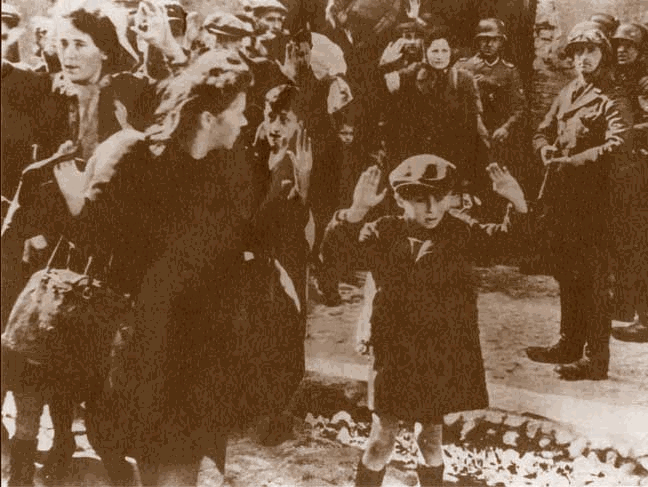
| I would like to be an artist
So I could make a Painting of you Little Polish Boy Standing with your Little hat
I would make a monument of you and the world who said nothing I would like to be a composer
Standing with your Little hat
I would write a concerto of you and the world who said nothing |
I am not an artist
But my mind had painted a painting of you Ten Million Miles High is the Painting
Standing with your Little hat
And the World who said nothing I'll make this painting so bright
Ten billion miles high will be the monument
Standing with your Little hat
|
Standing in the ghetto
with your arms up as many Nazi machine guns pointing at you And the monument will tremble so the blind world
The world
I am not a composer
The world's
I
|
"Poem from the Archives of the Simon Wiesenthal Center,
Los Angeles, California"
©1994 Peter L. Fischl
Monday - Literature
Thoreau - Civil Disobedience
Tuesday - Audio Clips
Ghandi - Speeches
Tuesday - Food for Thought
"If we could shrink the entire Earth's population to a village of precisely 100 people. With all existing human ratios remaining the same, it would look like this:
"I have a Dream - The Life of Dr. Martin Luther King, Jr."
Monday - Essay
Virginia Woolf - "Shakespeare's Sister"
Wenesday - Short Story
Kate Chopin - "The Story of an Hour"
"Desiree's Baby"
Outcomes (Objectives)
Students will use an appropriate medium and genre to communicate
their ideas and influence an audience.
(Cognitive Level: Medium - Application)
Benchmarks ELA 4.1, 6.4, 8.2 or 8.3, 8.4, 8.5
Students will use appropriate written and oral techniques
within their chosen genre for the purpose of conveying meaning and influencing.
This includes choice of language, grammar, rhetorical technique, voice
and conventions.
(Cognitive Level: Low - Comprehension, Medium - Application)
Benchmarks ELA 2.1, 2.2, 2.3, 2.4, 3.7, 4.4, 4.5,
6.4
Students will use various resources to gather information
to support their views.
(Cognitive Level: Medium - Analysis, High - Synthesis)
Benchmarks ELA 9.1, 9.2, 10.1, 11.2, 11.3
Students will use various resources to gather information
to strengthen their technique.
(Cognitive Level: Medium - Analysis, High - Synthesis)
Benchmarks ELA 6.2, 8.1, 8.4, 8.5, 11.4
Students will draft, edit and revise their works to produce
a highly refined finished product.
(Cognitive Level: High Synthesis & Evaluation)
Benchmarks ELA 7.2, 7.4
Students will include a self-evaluation of their project
in which they assess their effectiveness using given criterion.
(Cognitive Level: High - Evaluation)
Benchmarks ELA 6.1, 6.2, 7.2
The purpose of this project is to allow you, as ******** High School Students and members of our community, to address an issue of personal importance and to develop your creative skills. You will be developing a creative project of your choice that expresses your views on a social issue. This project should be something that could be displayed to the public for the purpose of raising their awareness and influencing their beliefs.
STEPS TO FOLLOW
PART ONE
| Technique | Production | Persuasiveness | |
| Excellent | Genre-appropriate use of grammar, syntax, voice and conventions. If there is deviation from conventional usage, it is well-justified. Genre is well-developed. | Highly polished end-product. Aesthetics are genre appropriate and production is well organized. Quality workmanship. Work has been thoroughly edited and revised. | Well-supported stances that are presented in a manner which is likely to persuade audiences. Highly logical presentation. |
| Good | Few mistakes in usage. Genre is clear, but not completely developed. | Incomplete editing and revision. Workmanship is good, but could be improved. | Stances are supported by evidence and logic. Presentation is good, but could be improved. |
| Mediocre | Moderate technical errors. The genre is not fully developed and unclear.. | Mediocre editing and revisions. | Stances are moderately supported by evidence and logic. Presentation is moderately persuasive. |
| Poor | Numerous spelling, grammar, and convention mistakes. Meaning and persuasiveness are compromised. The genre is poorly developed. | Sloppy workmanship. The aesthetics are inappropriate for the chosen genre. Little or no editing and revision. | Stances are not supported and illogical. Presentation is not persuasive. |
PART TWO
PART THREE
DUE DATES
Day 2 - Turn in choice of genre and issue.
Day 5 - Submit bibliography of resources used in research.
Day 6 - Submit first draft for peer editing.
Day 8 - Submit revised draft to instructor for initial grade on Part One.
Day 13 - Submit final draft to instructor for final grade on Part One.
Day 15 - Submit Self-Evaluation.
Day 17 - In-Class presentations begin.
Your overall grade for the project will be based on the
finished product of Part One (65%), your Self-Evaluation (10%) and your
In-Class Presentation (25%). Part One will be graded based on the rubric
that I have provided. The Self-Evaluation will be graded as an essay. Use
proper grammar, spelling and conventions. Most importantly, be thoughtful.
The In-Class presentation will be evaluated on the degree of preparedness,
the persuasiveness of your stance and the clarity with which you present
the issue.
Scoring Rubric
Part One (60 Points - 20 points for each area)
| Technique | Production | Persuasiveness | |
| Excellent | Genre-appropriate use of grammar, syntax, voice and conventions. If there is deviation from conventional usage, it is well-justified. Genre is well-developed. | Highly polished end-product. Aesthetics are genre appropriate and production is well organized. Quality workmanship. Work has been thoroughly edited and revised. | Well-supported stances that are presented in a manner which is likely to persuade audiences. Highly logical presentation. |
| Good | Few mistakes in usage. Genre is clear, but not completely developed. | Incomplete editing and revision. Workmanship is good, but could be improved. | Stances are supported by evidence and logic. Presentation is good, but could be improved. |
| Mediocre | Moderate technical errors. The genre is not fully developed and unclear. | Mediocre editing and revisions. | Stances are moderately supported by evidence and logic. Presentation is moderately persuasive. |
| Poor | Numerous spelling, grammar, and convention mistakes. Meaning and persuasiveness are compromised. The genre is poorly developed. | Sloppy workmanship. The aesthetics are inappropriate for the chosen genre. Little or no editing and revision. | Stances are not supported and illogical. Presentation is not persuasive. |
Self-Evaluation (10 Points)
The evaluation must be clearly written according to traditional usage conventions. The evaluation must address the effectiveness of Part One and indicate self-reflection.
Presentation (30 Points)
I have scored the performance assessment based on the amount that I felt each section addressed the content standards. The rubric for part one corresponds to the different areas that were involved in the creation of the project. Technique addresses the issues of genre choice and ability to write within that genre. Production addresses the performance aspect of the project. The end product is to be presented to an audience in a professional manner. Persuasiveness addresses the research aspect of the product. Stances need to be well supported and arguments need to be thoroughly thought out.
Self-evaluation is an important component of the content standards. This section was given ten percent of the total weight because of the relative amount of work and thought that would go into developing it on the part of the students.
For the same reason, 30 percent of the grade was given to the presentation.
This project is designed for use in high school English classes. The cognitive levels are appropriate for this age group and the project itself is relevant to their approaching entry into the adult world, where they will need to have well-thought positions on pertinent social issues.
Adaptation:
For students who didn't have the pre-requisite communication
and critical thinking skills this project would still be appropriate because
of its pedagogical values. The project would only need to be adapted to
include more instructor supervision. Students would be given extra guidance
in the completion of each of the separate stages. This would include provision
of examples of the various stages. Further, students would be allowed further
revision opportunities to adjust to instructor expectations.